

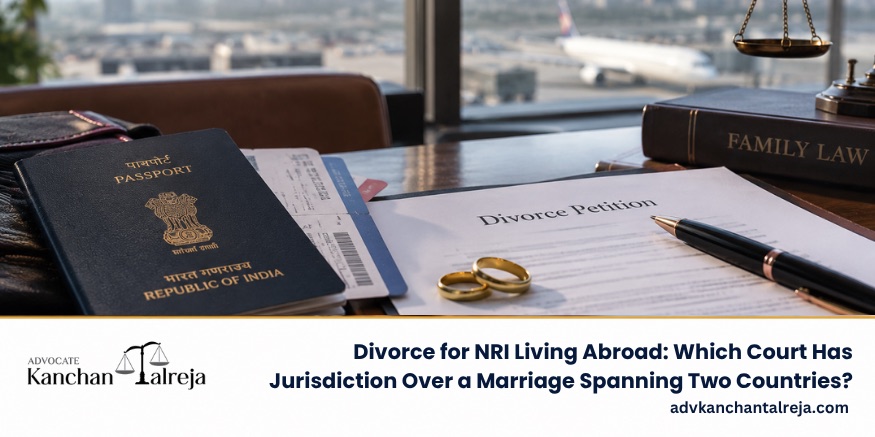
In an NRI divorce in India, the first question is not whether grounds for dissolution exist, but which court is competent to entertain the petition. When spouses are settled in different countries, or when a marriage solemnized in India is followed by a period of residence abroad, proceedings may be instituted in more than one forum. The result may be conflicting orders, a decree that is unenforceable in the country where it is most needed, or prolonged litigation over the preliminary issue of jurisdiction.
Determining the competent court governs the substantive grounds available, the relief that may be granted regarding maintenance and custody, and, critically, whether the resulting decree will be recognized in the other jurisdiction. Legal practitioners specializing in cross-border family law, such as Advocate Kanchan Talreja, often emphasize that navigating these preliminary jurisdictional questions early on is crucial to avoiding parallel proceedings and conflicting decrees. This article examines the statutory framework, the rules of territorial jurisdiction, the law applicable to the parties, the recognition of foreign decrees, and the procedural aspects of divorce for NRI living abroad.
Governing Statutory Framework
The law applicable to a matrimonial dispute in India depends on the personal law of the parties and the manner in which the marriage was solemnised or registered. The principal enactments are as follows:
- The Hindu Marriage Act, 1955: Under Section 1(2), the Act extends to the whole of India and also applies to Hindus domiciled in the territories to which it extends who are outside those territories. An NRI who is domiciled in India therefore remains subject to the Act.
- The Special Marriage Act, 1954 governs civil marriages irrespective of religion. By Section 1(2), it also applies to citizens of India domiciled in India who are outside India.
- The Foreign Marriage Act, 1969 provides for the solemnisation and registration of marriages abroad where at least one party is a citizen of India. It extends the marriage remedies of SMA to such marriages.
- The Parsi Marriage and Divorce Act, 1936, the Divorce Act, 1869 and the Dissolution of Muslim Marriages Act, 1939 apply to the respective communities.
It must be noted that the place of solemnization, the place of registration and the personal law of the parties do not always coincide. A couple who marry in a religious ceremony in India and subsequently register the marriage in a foreign country may be governed by two sets of laws for different purposes. The identification of the applicable statute is accordingly the foundation on which every jurisdictional argument rests. In any divorce for NRI living abroad, this exercise must precede the choice of forum, often requiring guidance from an experienced NRI divorce lawyer in India.
Territorial Jurisdiction of Indian Courts
Territorial jurisdiction in matrimonial proceedings is regulated by statute and not merely by the general provisions of the Code of Civil Procedure, 1908.
Section 19, Hindu Marriage Act
A petition under the HMA must be presented to the district court within the local limits of whose ordinary original civil jurisdiction:
- the marriage was solemnised;
- the respondent resides at the time of presentation of the petition;
- the parties to the marriage last resided together;
- the wife, where she is the petitioner, is residing on the date of presentation; or
- the petitioner is residing, where the respondent is at that time residing outside the territories to which the Act extends, or has not been heard of as being alive for a period of seven years.
The last limb is of particular relevance to NRI divorce in India. Where the respondent spouse resides abroad, the petitioner resident in India may institute proceedings before the court at the place of the petitioner’s own residence. Section 31 of the Special Marriage Act, 1954 contains corresponding provisions.
Family Courts
Where a Family Court has been established for the area, Section 7 of the Family Courts Act, 1984 vests it with the jurisdiction exercisable by a district court in matrimonial causes, and the petition is to be presented before that court.
Choice of forum
Section 19 does not establish a hierarchy among the available courts. When more than one court is competent, the petitioner has discretion to choose the forum. That discretion, however, is subject to the principle that the proceedings must not be instituted for the purpose of harassment, and to the power of the court to transfer proceedings in appropriate cases under Section 24 of the Code of Civil Procedure, 1908, and Section 25 thereof (before the Supreme Court).
Domicile, Residence and Applicable Law
Three concepts are frequently conflated in cross-border matrimonial disputes: nationality, residence and domicile.
- Nationality denotes citizenship of a State.
- Residence denotes the place where a person lives, whether temporarily or for an extended period.
- Domicile denotes the place a person regards as a permanent home, coupled with the intention to remain there.
In proceedings before an Indian court, the grounds for dissolution are determined by the personal law governing the marriage, and not by the law of the country in which the parties happen to reside. A Hindu couple resident in a foreign State, whose marriage was solemnised under Hindu rites, remains subject to the grounds enumerated in Section 13 of the HMA (or the mutual consent provisions of Section 13B), regardless of the grounds available under the foreign law.
Difficulties arise where the parties have acquired foreign citizenship. The acquisition of citizenship does not by itself alter the personal law under which the marriage was solemnised. Still, it may bear on the question of domicile and on the jurisdiction of the foreign court. Courts examine whether the domicile was genuinely acquired or established merely to find jurisdiction. The divorce process for NRIs is accordingly fact-sensitive. Consulting a knowledgeable divorce lawyer for NRI matters can help ensure that the residence history of both spouses is carefully documented.
Recognition of Foreign Divorce Decrees in India
Acknowledging a decree of divorce obtained abroad is the most litigated aspect of cross-border matrimonial law. A divorce for NRI living abroad that is valid in the country of residence may nonetheless be treated as a nullity in India.
Section 13, Code of Civil Procedure, 1908
Under Section 13, a foreign judgment is conclusive on any matter directly adjudicated between the parties, except where it:
- has not been pronounced by a court of competent jurisdiction;
- has not been rendered on the merits of the case;
- appears on the face of the proceedings to be based on an incorrect view of international law or on a refusal to recognize Indian law where such law is applicable;
- was obtained in proceedings that were opposed to natural justice;
- has been obtained by fraud; or
- sustains a claim founded on a breach of any law in force in India.
Section 14 creates a presumption of competence in favor of a certified copy of a foreign judgment, but that presumption is rebuttable.
Y. Narasimha Rao v. Y. Venkata Lakshmi (1991) 3 SCC 451
The Supreme Court laid down the governing test in this decision. As a general rule, a foreign matrimonial judgment will be recognised in India only if the foreign court assumed jurisdiction, and granted relief on a ground, available under the matrimonial law under which the parties were married. The Court recognised three exceptions:
- where the proceedings were brought in the forum where the respondent is domiciled or habitually and permanently resides, and relief is granted on a ground available under the parties’ matrimonial law;
- where the respondent voluntarily and effectively submits to the jurisdiction of the foreign court and contests the claim on a ground available under the parties’ matrimonial law; or
- where the respondent consents to the grant of relief, even though the foreign court’s jurisdiction is not in accordance with the parties’ matrimonial law.
The Court rejected the proposition that the mere residence of the petitioner for a short period in the foreign State is sufficient to confer jurisdiction. The decision proceeds on the premise that the rights of the parties are governed by the law under which they married, and that those rights should not be defeated by the unilateral choice of a more convenient forum.
Satya v. Teja Singh (1975) 1 SCC 120
In this ruling, the Supreme Court refused to acknowledge a foreign court’s decree because the petitioner claimed a domicile that was not legitimately obtained. The decree was deemed invalid for lack of jurisdiction and fraud.
Section 44A and ex parte decrees
Section 44A of the Code relates to the execution of decrees of courts in reciprocating territories, and is directed at money decrees. It does not extend to divorce decrees, which are tested under Section 13. A decree passed ex parte, without effective service on the respondent, is particularly vulnerable to challenge on the ground of natural justice and the absence of submission to jurisdiction.
A party who intends to rely on a foreign decree for the purposes of remarriage, succession or a passport application should therefore ensure, at the outset, that the decree satisfies the Narasimha Rao test. The question of whether an Indian decree will be recognised abroad is governed by the law of the foreign State, and local advice is required.
Parallel Proceedings and Anti-Suit Relief
Where one spouse files in India and the other abroad, each court must determine whether to proceed. The principles of comity of courts and forum non conveniens inform that decision. A court will ordinarily consider whether the foreign forum is the natural forum, the connection of the parties to each jurisdiction, and whether continuation of the foreign proceedings would be oppressive or vexatious.
In Modi Entertainment Network v. W.S.G. Cricket Pte. Ltd. (2003) 4 SCC 341, the Supreme Court set out the principles governing the grant of anti-suit injunctions, holding that such relief is to be exercised sparingly and with caution, having regard to the principle of comity. In matrimonial matters, Indian courts have applied these principles in considering whether foreign proceedings should be restrained, a complex legal remedy where a specialized divorce lawyer for NRI cases plays a crucial role.
The date of institution is a relevant but not determinative factor. A first-filed petition does not oust the jurisdiction of the second court, but the pendency of earlier proceedings, and the risk of conflicting decrees, will weigh in the exercise of the court’s discretion. A party that submits to the foreign court without reservation may later be held to have accepted its jurisdiction for the Narasimha Rao test. The manner of any appearance abroad must therefore be considered with care.
Ancillary Reliefs and Jurisdiction
The forum for dissolution is not always the forum for ancillary relief.
Maintenance and alimony. Interim maintenance and permanent alimony may be claimed under Sections 24 and 25 of the HMA in matrimonial proceedings. Navigating an NRI maintenance and alimony claim in India also involves considering statutory provisions across personal laws. Additionally, maintenance may be sought under Section 144 of the Bharatiya Nagarik Suraksha Sanhita, 2023 (which corresponds to the former Section 125 of the Code of Criminal Procedure, 1973). Under Section 145 BNSS (formerly Section 126 CrPC), the application may be filed where the respondent is or resides, where the claimant resides, or where the respondent last resided with the claimant. A foreign maintenance order does not necessarily bar an application in India.
Child custody. The paramount consideration in every proceeding concerning a minor is the welfare of the child. Under Section 9 of the Guardians and Wards Act, 1890, the application is ordinarily made to the court within whose jurisdiction the minor ordinarily resides. Section 26 of the HMA empowers the court to pass interim and final orders for custody in matrimonial proceedings. India is not a signatory to the Hague Convention on the Civil Aspects of International Child Abduction. In Nithya Anand Raghavan v. State (NCT of Delhi) (2017) 8 SCC 454, the Supreme Court held that the principle of comity of courts does not override the welfare of the child, and that a foreign custody order is a relevant but not a binding consideration for an Indian court.
Domestic violence. Section 27 of the Protection of Women from Domestic Violence Act, 2005 permits an application before the Magistrate within whose jurisdiction the aggrieved person permanently or temporarily resides or carries on business, the respondent resides, or the cause of action has arisen.
Divorce Process for NRIs: Procedural Considerations
The divorce process for NRIs raises practical considerations that do not arise in a purely domestic dispute.
- Service of summons abroad. Where the respondent resides outside India, summons may be served through the channels prescribed by the Code of Civil Procedure and, where applicable, in accordance with the Hague Service Convention, to which India is a party. The court may also permit service by e-mail or other electronic modes in appropriate cases. Valid service is essential for the validity and enforceability of any resulting decree.
- Appearance. Appearance via video conferencing or through a duly authorized power of attorney is subject to the court’s permission and, where required by law, the consent of the parties. Personal presence may be required at certain stages, including recording statements in a mutual consent petition.
- Documents. Documents executed abroad must be duly attested and, for States that are parties to the Apostille Convention, apostilled. Documents from other States require consular attestation.
- Mutual consent. Section 13B of the HMA prescribes six months between the first and second motions. In Amardeep Singh v. Harveen Kaur (2017) 8 SCC 746, the Supreme Court held that the period is directory and may be waived where the conditions specified are satisfied. In Shilpa Sailesh v. Varun Sreenivasan, 2023 SCC On-line SC 544, a Constitution Bench of the Supreme Court held that it may, under Article 142 of the Constitution, dissolve a marriage on the ground of irretrievable breakdown. This power is exercisable only by the Supreme Court, not by Family Courts or High Courts.
Given the interaction of Indian procedure, foreign law and the requirements of recognition, parties to a cross-border dispute generally engage a divorce lawyer for NRI matters who is conversant with service of process, attestation requirements and cross-border enforcement.
The jurisdiction of the court in an NRI divorce in India depends on the personal law of the parties, the statutory provisions governing territorial competence, and the principles governing the recognition of foreign decrees. Section 19 of the Hindu Marriage Act and Section 31 of the Special Marriage Act identify the Indian courts competent to entertain the petition. Section 13 of the Code of Civil Procedure, as interpreted in Y. Narasimha Rao, determines whether a foreign decree will be recognised in India.
A jurisdictional defect is difficult to cure once a decree has been passed. The forum should therefore be determined at the outset, with regard to the residence history of the parties, the law under which the marriage was solemnised, and the relief sought in respect of maintenance and custody.
For tailored legal guidance regarding your situation, consulting an experienced legal professional like Advocate Kanchan Talreja can help clarify your options and protect your rights in cross-border matrimonial matters.
DISCLAIMER:
The information on this page is general legal information and is not legal advice or a legal opinion. Every matter depends on its own facts and the applicable law. Reading this page, or contacting Advocate Kanchan Talreja through this website, does not create a lawyer–client relationship. No particular outcome is guaranteed. Please take legal advice on your specific situation before acting on anything on this page.
References:
- Government of India. (1955). The Hindu Marriage Act, 1955 (Act No. 25 of 1955). Ministry of Law and Justice. India Code. India Code – Hindu Marriage Act, 1955
- Government of India. The Special Marriage Act, 1954. Ministry of Law and Justice. India Code. India Code – Special Marriage Act, 1954
- Government of India. (1936). The Parsi Marriage and Divorce Act, 1936 (Act No. 3 of 1936). Ministry of Law and Justice. India Code. India Code – Parsi Marriage and Divorce Act, 1936
- Government of India. (1869). The Divorce Act, 1869 (Act No. 4 of 1869). Ministry of Law and Justice. India Code. India Code – Divorce Act, 1869
- Government of India. (1939). The Dissolution of Muslim Marriages Act, 1939 (Act No. 8 of 1939). Ministry of Law and Justice. India Code. India Code – Dissolution of Muslim Marriages Act, 1939
- Government of India. (1908). The Code of Civil Procedure, 1908 (Act No. 5 of 1908). Ministry of Law and Justice. India Code. India Code – Code of Civil Procedure, 1908
- Government of India. (1890). The Guardians and Wards Act, 1890 (Act No. 8 of 1890). Ministry of Law and Justice. India Code. India Code – Guardians and Wards Act, 1890
- Government of India. (1956). The Hindu Succession Act, 1956 (Act No. 30 of 1956). Ministry of Law and Justice. India Code. India Code – Hindu Succession Act, 1956
- Government of India. (1956). The Foreign Marriage Act, 1969. Ministry of Law and Justice. India Code. India Code – Foreign Marriage Act, 1969
- Government of India. (1984). The Family Courts Act, 1984 (Act No. 66 of 1984). Ministry of Law and Justice. India Code. India Code – Family Courts Act, 1984
- Government of India. (2023). The Bharatiya Nagarik Suraksha Sanhita, 2023 (Act No. 46 of 2023). Ministry of Law and Justice. India Code. India Code – Bharatiya Nagarik Suraksha Sanhita, 2023